


Top things to know
- North Korea carried out an intermediate-range strategic missile firing drill toward the East Sea, overseen by leader Kim Jong-un [S1].
- State media reported the test involved a hypersonic strategic weapon system with low-altitude orbit-changing capabilities and AI integration [S1, S5].
- Kim Yo-jong claimed that South Korea and Japan failed to track the missile's trajectory due to a special wave-like flight mode [S1].
- South Korea's military detected the launch from the Wonsan area, reporting a flight distance exceeding 700 kilometers [S1].
- The South Korean defense ministry denounced the launch as a violation of U.N. Security Council resolutions while asserting that allied defense assets remain capable of detection and interception [S1].
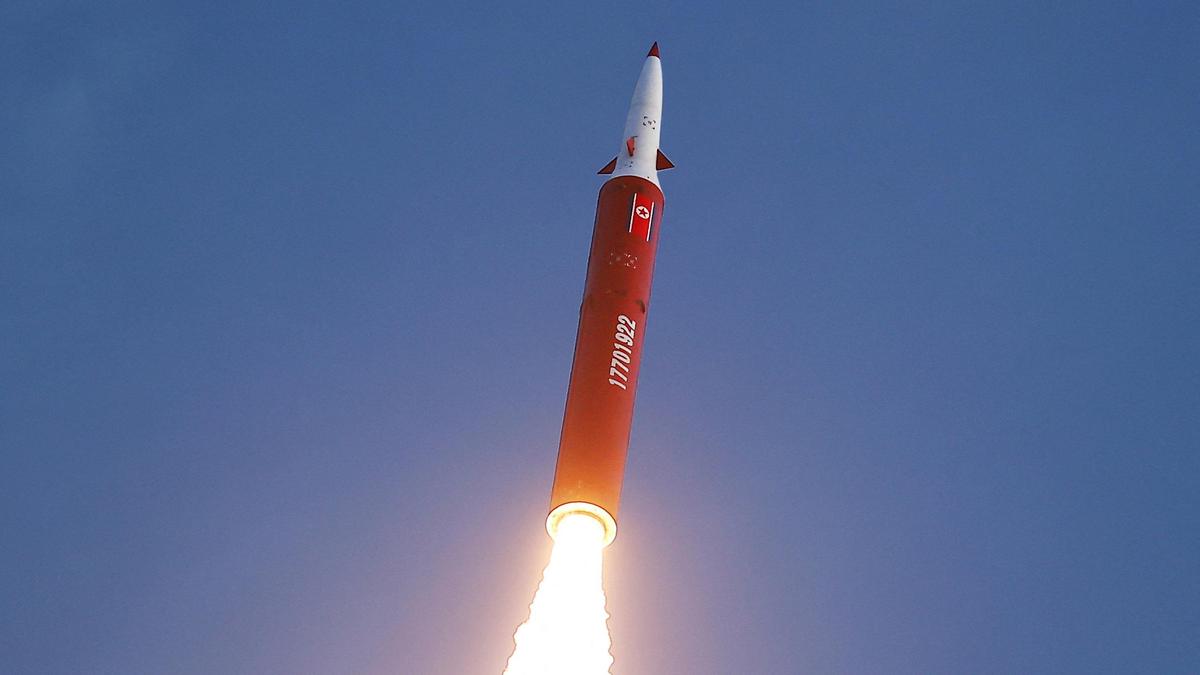
North Korea conducted a firing drill involving an intermediate-range strategic missile toward the East Sea at dawn on Saturday, with state media reporting that the launch was overseen by leader Kim Jong-un [S1]. According to the Korean Central News Agency (KCNA), the drill was designed to train missile troops operating a hypersonic strategic weapon system and to assess the reliability and efficiency of the country's war deterrent [S1, S3]. State media noted that the missile traveled and struck a target located 1,000 kilometers away [S1].
Kim Jong-un stated that the launch aimed to continuously demonstrate the counterattack readiness of the nation's military and to repeatedly emphasize the reliability of its strategic offensive capabilities [S1]. Photos published by state media outlets showed the North Korean leader observing the test alongside his family members [S1]. Experts discussing the reports suggested the test may have involved the Hwasong-16 Na hypersonic medium-range ballistic missile, pointing to descriptions of the weapon's low-altitude flight orbit adjustments [S1].
Kim Yo-jong, the influential sister of the North Korean leader, released a swift statement following the drill claiming that military authorities in South Korea and Japan failed to accurately track the trajectory of the missile [S1]. She attributed this alleged failure to tracking limitations and the employment of a special wave-like trajectory mode designed to evade interception [S1, S3]. Furthermore, state reports indicated that artificial intelligence technology was integrated into the missile system to enable orbit modifications during flight [S5].
In response to the activity, South Korea's Joint Chiefs of Staff reported detecting a ballistic missile launched from the Wonsan area that flew over 700 kilometers [S1]. The South Korean defense ministry subsequently denounced the launch as a severe violation of United Nations Security Council resolutions [S1]. While condemning the actions for escalating regional tensions, the ministry maintained that combined defense assets between South Korea and the United States possess the capability to detect and intercept such projectiles [S1].
The missile test occurred amid an already tense geopolitical climate following an incident last month inside the Demilitarized Zone (DMZ), where a landmine blast left three South Korean soldiers injured [S1]. South Korean military authorities attributed the explosion to North Korean border fortification activities and demanded an official apology [S1, S5]. Pyongyang denied responsibility for the incident, dismissed Seoul's findings, and warned of stern retaliatory measures against any subsequent actions taken by the South [S1].